Performance & Benchmarks
Python-Blosc2 is engineered around a central premise: modern computation is memory-bound, not CPU-bound. Over recent decades, processor clock speeds and core counts have outpaced memory bus bandwidth and storage I/O speeds (the classic “Memory Wall”).
By compressing data with ultra-fast, SIMD-accelerated codecs and structuring arrays into two-level cache-aligned hierarchies (chunks and blocks), Python-Blosc2 often transmits less data over the memory bus, allowing computations and I/O to run significantly faster than with uncompressed data.
This document breaks down the architectural mechanics and benchmark results that illustrate how Python-Blosc2 achieves high performance across in-memory computations, out-of-core processing, and columnar queries.
1. Compression as an Accelerator
Traditional compression libraries focus primarily on archival: achieving maximum compression ratios at the expense of CPU time. In contrast, Blosc2 focuses on real-time transmission acceleration: making compression and decompression so fast that transferring compressed data through memory, disk, or network takes less total time than transferring uncompressed bytes.
Serialization and Codec Throughput
Blosc2 supports a variety of modern codecs (BloscLZ, LZ4, LZ4HC, Zstandard, and Zlib) combined with byte-shuffling and bit-shuffling filters:
Compression Speed |
Decompression Speed |
|---|---|
|
|
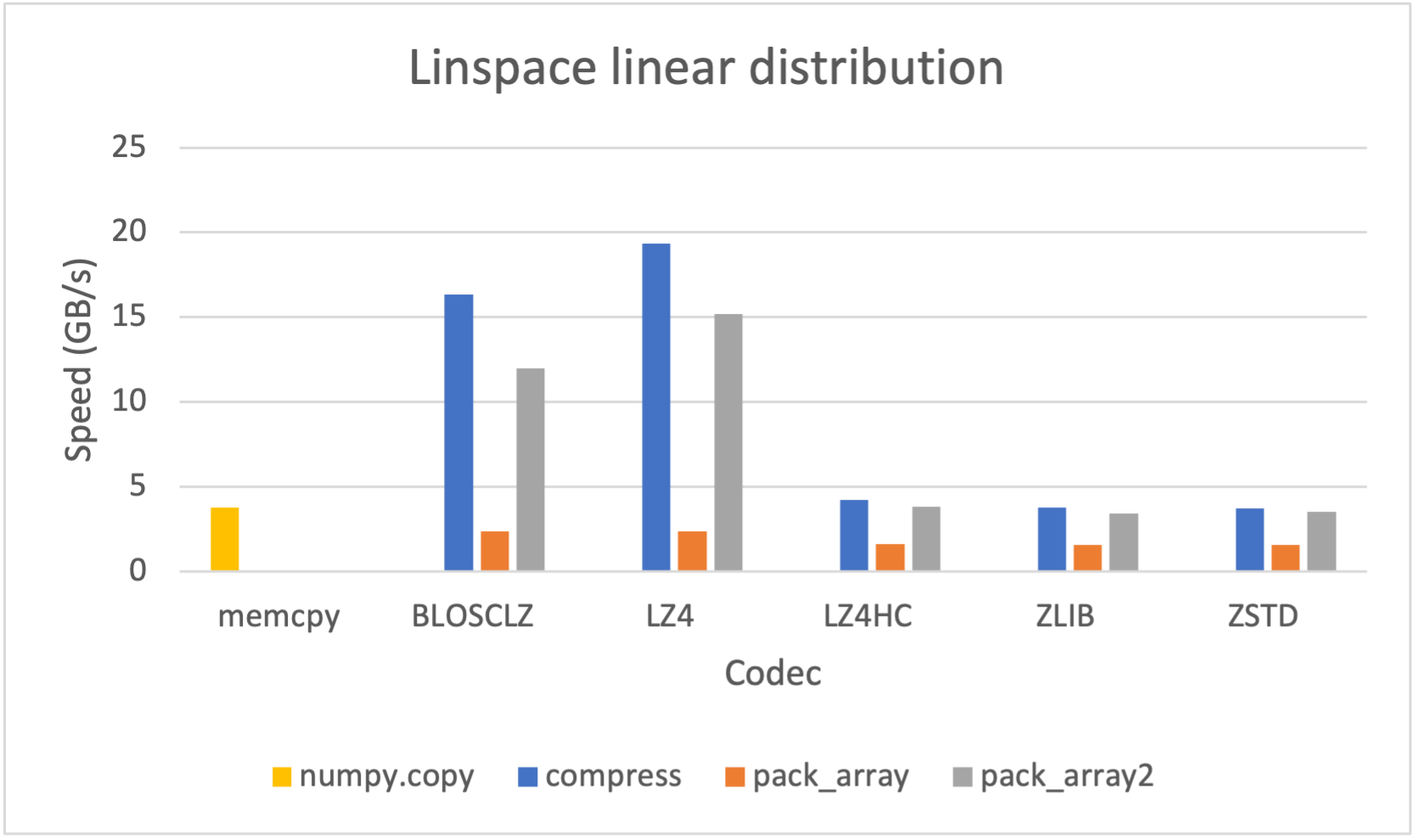
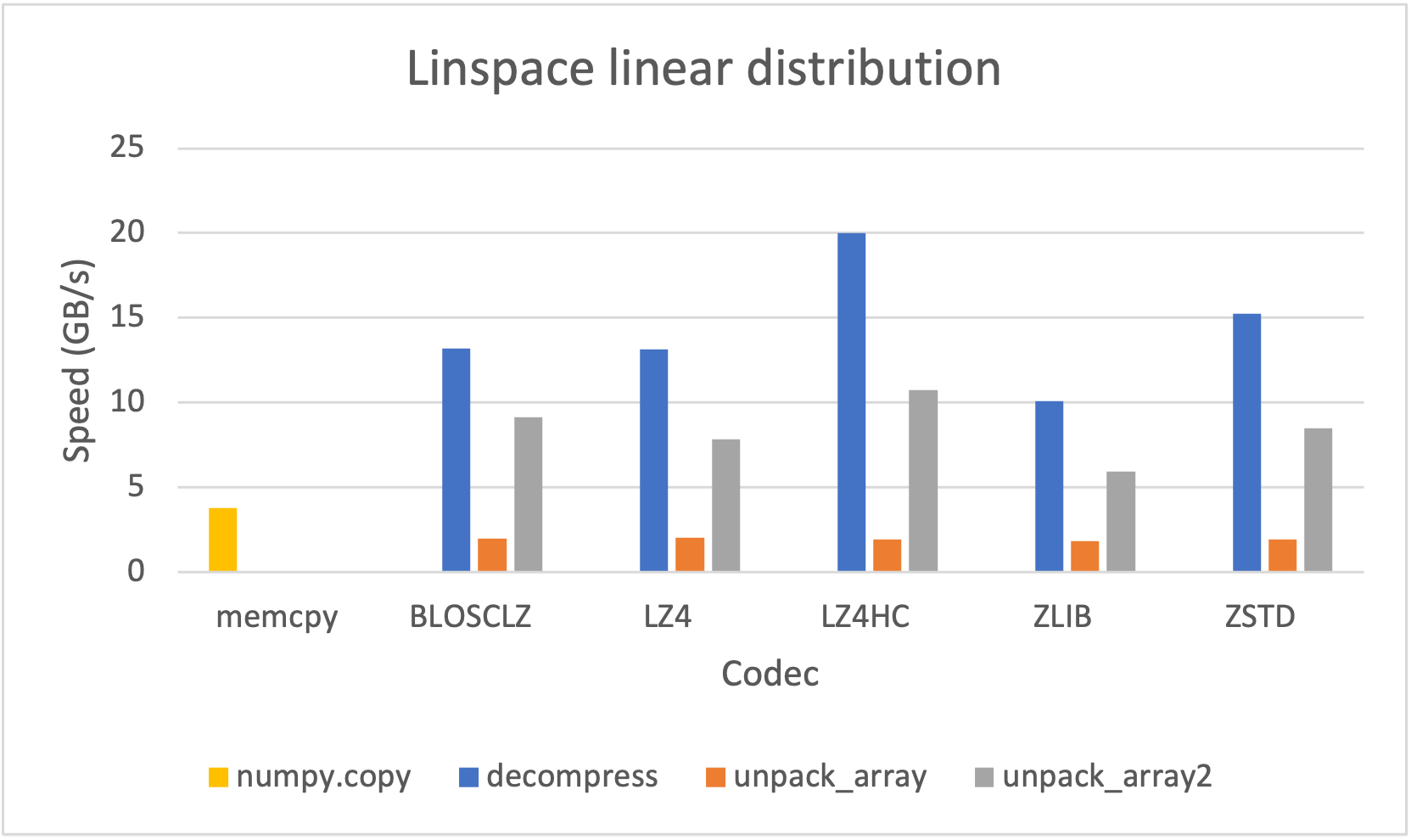
Fast Codecs (LZ4, BloscLZ): Reach speeds exceeding 10–20 GB/s on multi-core CPUs, operating near memory-bus wire speeds while reducing footprint.
High-Ratio Codecs (Zstandard): Deliver substantial compression ratios while still decompressing at multi-gigabyte-per-second rates.
Compression Ratios Across Datatypes
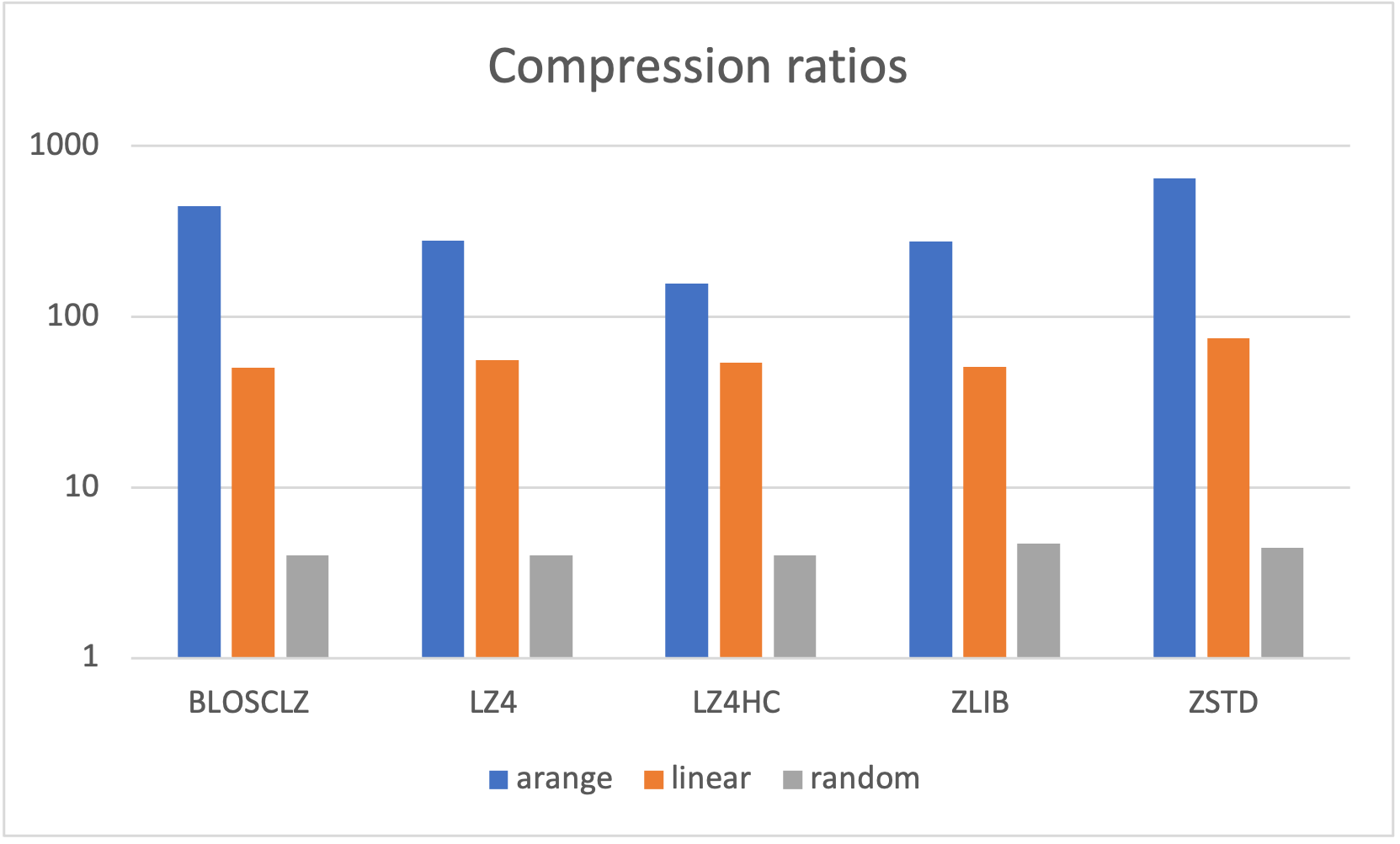
Filters like SHUFFLE, BITSHUFFLE, and BYTEDELTA rearrange bytes so that neighboring elements with similar values compress significantly better, often achieving 5x–20x compression on scientific floating-point data without loss of precision.
Learn More & Deep Dives
Tutorial 07: SChunk Basics — Managing raw compressed chunk storage.
Tutorial 09: User Codecs & Filters — Writing custom Python/C codecs and filters.
2. Double Partitioning & Multi-Dimensional Slicing
Traditional chunked storage formats divide N-dimensional arrays into single-level chunks. While this works well for coarse I/O, fetching a small slice or cross-section requires decompressing entire chunks.
Python-Blosc2 solves this with two-level double partitioning:
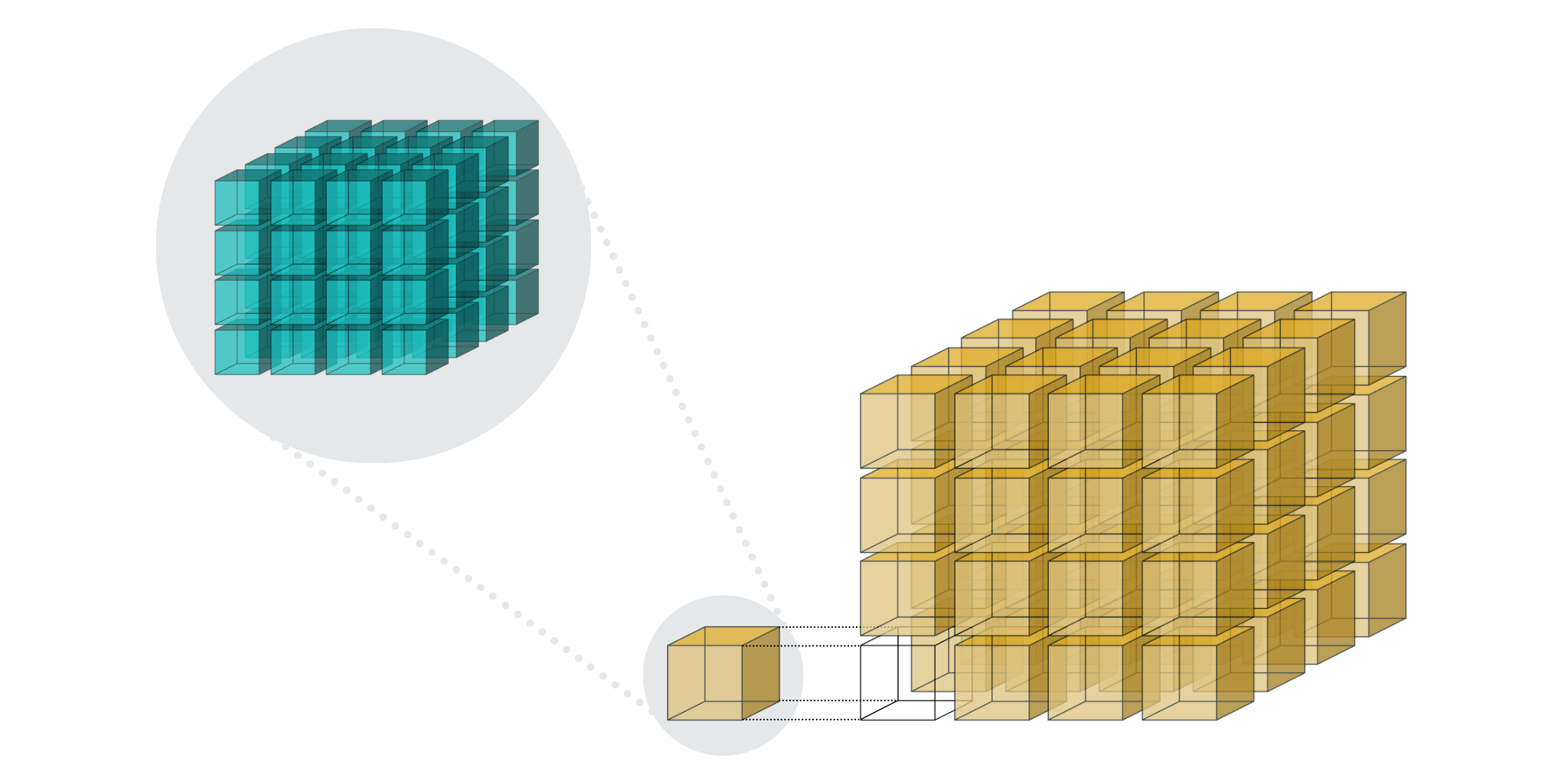
Chunks (First Level): Coarse partitions sized for disk/network I/O (typically 1 MB – 64 MB).
Blocks (Second Level): Fine-grained partitions sized to fit directly into CPU cache (typically 32 KB – 512 KB, matching L1/L2/L3 cache lines).
Orthogonal Slicing Performance
Because each chunk contains indexed blocks, slicing an N-dimensional array along any axis (“pineapple-style” slicing) only requires decompressing the relevant blocks rather than whole chunks:
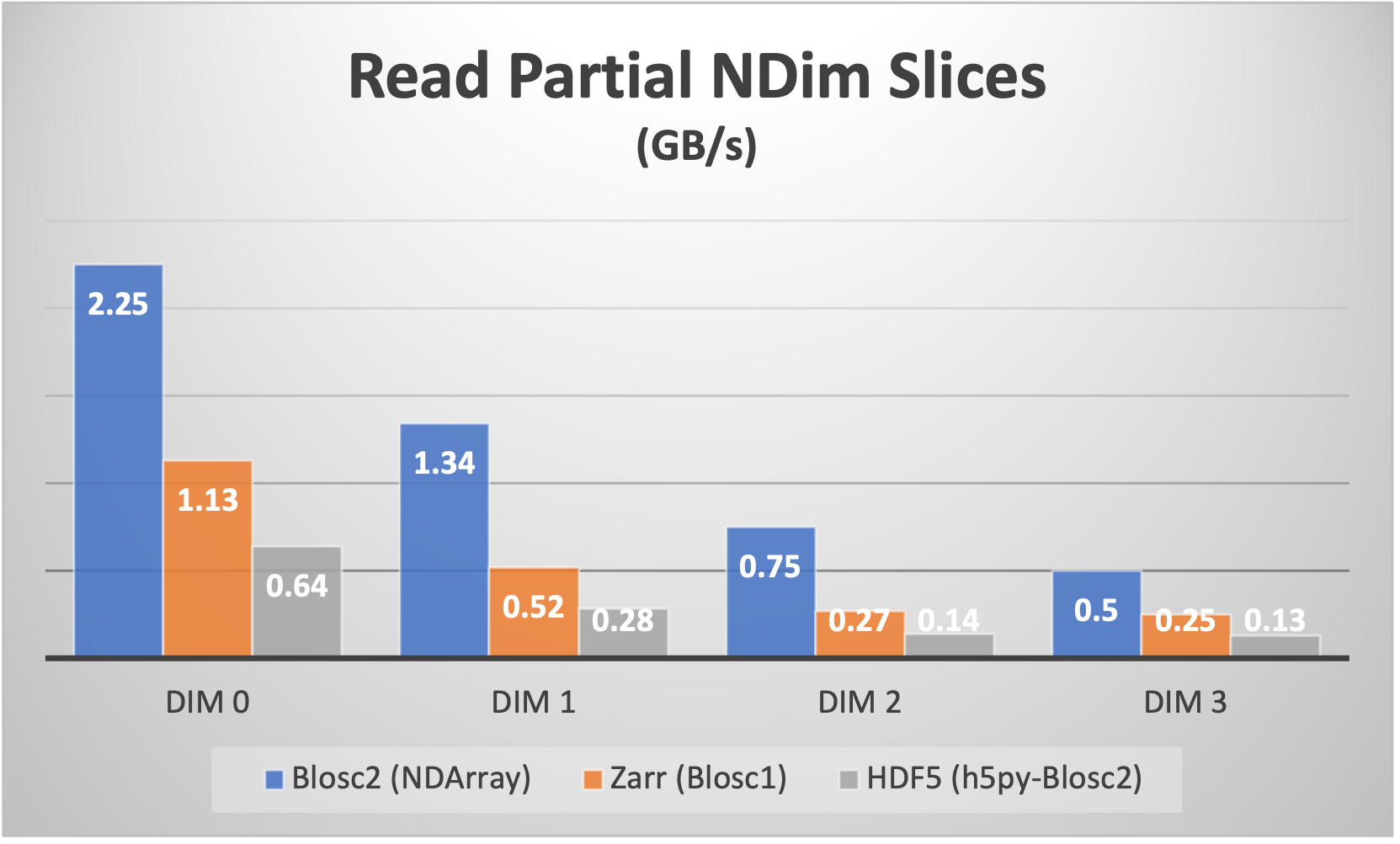
This architecture maintains high read throughput regardless of whether data is sliced along the row axis, column axis, or deeper tensor dimensions.
Learn More & Deep Dives
Tutorial 01: NDArray Basics — Working with N-dimensional compressed arrays.
Optimization Tip 02: Chunk-aligned Slicing — Structuring chunk shapes for maximum slicing speed.
Blog: Blosc2 NDim Introduction
3. Compute Engine & Lazy Expressions
Python-Blosc2 includes a high-speed compute engine designed for evaluating mathematical expressions directly on compressed data.
Expressions are represented lazily as LazyExpr or LazyArray instances, which execute chunk-by-chunk across threads, eliminating large intermediate uncompressed temporary arrays.
In-Memory Computation (Operands fit in RAM)
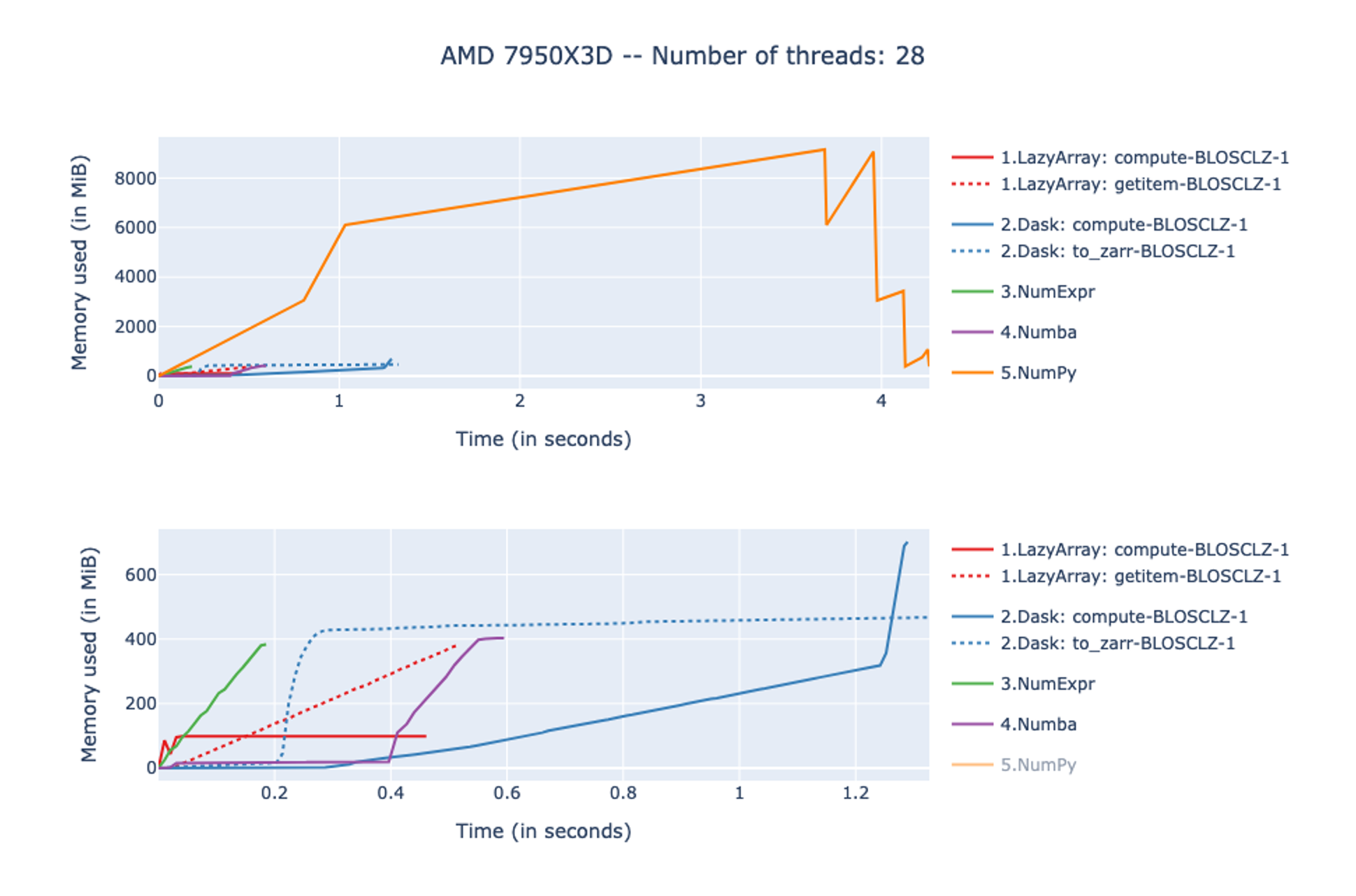
For datasets that fit in memory (e.g., $20,000 \times 20,000$ float64 elements, ~3.2 GB per operand), evaluating compound expressions such as:
$$\text{expr} = ((a^3 + \sin(c \cdot 2)) < b) \ \& \ (c > 0)$$
yields execution times that match or exceed top-tier computing libraries while consuming a fraction of the memory:
Out-of-Core Computation (Operands exceed RAM)
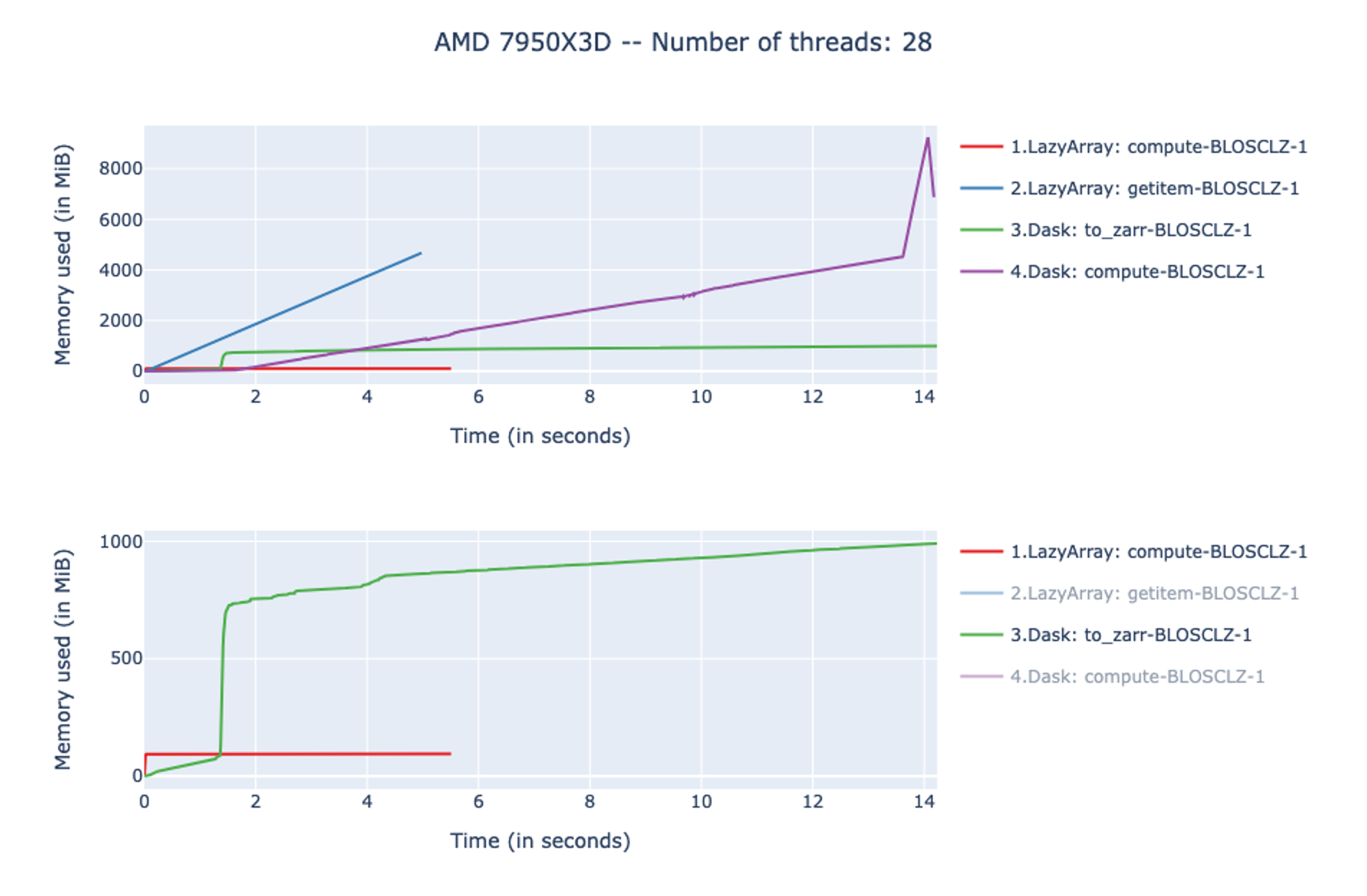
When arrays are too large to fit in memory uncompressed (e.g., $70,000 \times 70,000$ float64 elements, ~39 GB per operand), standard libraries like NumPy and NumExpr fail with MemoryError.
Python-Blosc2 processes data in compressed chunks from disk or memory, outperforming distributed frameworks like Dask+Zarr with dramatically lower CPU and memory overhead:
Persistent Reductions
Reductions (such as sum(), mean(), std(), min(), max()) can be performed directly over compressed arrays on disk. Results can be preserved dynamically inside persistent expressions, allowing repeated downstream queries without recomputing intermediate reduction passes.
JIT Compilation Acceleration
By setting the environment variable BLOSC_ME_JIT=cc, filter and reduction expressions are compiled on the fly with -O3 optimizations and SIMD auto-vectorization using the system C compiler (clang/gcc), delivering an additional ~30% speedup on large datasets.
Learn More & Deep Dives
Tutorial 02: Lazy Expressions — Constructing and computing with
LazyExpr.Tutorial 03: DSL Kernels — Fast compiled user-defined kernels.
Tutorial 04: Reductions — Optimizing reductions across large arrays.
Tutorial 05: Persistent Reductions — Dynamic reduction reuse.
4. Columnar Tables & Query Acceleration (CTable)
CTable is Python-Blosc2’s high-performance columnar container. Each column is a compressed NDArray, inheriting the chunking, compression, and multi-threading engine.
Key Architectural Advantages
No-Copy Querying: Filtering conditions like
(t.tips > 100) & (t.km > 0)evaluate directly over compressed columns in a single pass.Automatic SUMMARY Indexes: Min/max indexes are built per block at write time. During
where()queries, entire blocks that cannot contain matches are skipped without decompression.Fast Parquet & Arrow Interop: Direct single-call import and export to Parquet and Apache Arrow tables.
Tabular Query Benchmarks
On real-world tabular datasets like the Chicago Taxi dataset (~100M rows), queries on compressed CTable containers achieve speeds competitive with dedicated OLAP engines (such as DuckDB and Polars) while maintaining a smaller compressed footprint on disk and in memory.
Learn More & Deep Dives
Tutorial 13: CTable Basics — Building and querying tabular data.
Tutorial 15: Indexing CTables — Utilizing Summary Indexes for instant search.
Guide: Pandas Engine — Accelerating Pandas computations with Blosc2.
5. Distributed & Remote Array Acceleration
With Proxy and C2Array, Blosc2 containers transparently stream, cache, and slice datasets hosted on remote servers, HTTP endpoints, or cloud object stores (S3, GCS) via fsspec.
Byte-Range Reading: Only the precise byte offsets for required chunks and blocks are downloaded over the network.
LRU Chunk Caching: Frequently accessed chunks are automatically cached in local memory or disk, minimizing bandwidth consumption for repeated queries.
Learn More & Deep Dives
Tutorial 06: Remote Proxy — Client-side caching of remote datasets.
Guide: Remote Arrays — Connecting Blosc2 to fsspec, Caterva2, and cloud buckets.
6. Reproducing Benchmarks Locally
All benchmark scripts and Jupyter notebooks referenced in this guide are open-source and included in the Python-Blosc2 repository under bench/:
Category |
Benchmark Directory |
Description |
|---|---|---|
NDArray & Lazy Expressions |
In-memory and out-of-core expression evaluation, reductions, slicing, and JIT comparisons. |
|
Columnar Tables |
Table indexing, append/extend throughput, and row iteration. |
|
Tabular Comparisons |
Chicago Taxi benchmark comparing Blosc2 with DuckDB, Polars, PyArrow, and Pandas. |
|
Optimization Tips |
Reproducible scripts for all optimization tips. |
To run any benchmark locally:
# Clone the repository
git clone https://github.com/Blosc/python-blosc2.git
cd python-blosc2

# Run an NDArray expression benchmark
python bench/ndarray/lazyarray-constructors.py

# Run a CTable query comparison
python bench/ctable/ctable_v_pandas.py