Working with Remote Arrays
Blosc2 can open remote arrays and stores (arrays on a hierarchical container) without downloading them first. Source metadata is read at open time; array data is fetched when a slice needs it and retained according to the cache policy.
Python-Blosc2 provides two primary entry points for remote data:
RemoteArray: Access and slice an individual remote array (a standalone
.b2ndfile or a specific dataset in a container).RemoteStore: Discover, navigate, and access multi-dataset hierarchies in B2Z, Zarr, or HDF5 containers, sharing a single cache budget across all leaves.
import blosc2

# Discover and read from a remote container (B2Z, Zarr, or HDF5)
with blosc2.RemoteStore("https://datasets.example.org/data.h5") as store:
    print(store.keys())  # discover groups and datasets
    group = store["experiment"]
    array = group["temperature"]  # yields a RemoteArray leaf
    values = array[:100]  # fetches only the requested slice
    attrs = array.attrs[:]  # fetches user metadata

# Or open a single remote array directly
a = blosc2.open("s3://bucket/big.b2nd", lazy=True)
values = a[:100]
attrs = a.attrs[:]  # fetches user metadata
The b2view terminal browser uses these public types with a 64 MiB allowance by default to let you explore remote containers interactively.
For a script showing hierarchy discovery, leaf previews, and persistent caching, see examples/remote/store-browse.py.
Choose a remote route
The argument passed to blosc2.open() selects the route:
Argument |
Route |
What it names |
|---|---|---|
A URL string such as |
fsspec |
A byte-addressable, standalone |
A URL containing a |
B2Z |
One immutable external NDArray leaf in a |
A URL containing a |
Zarr |
One immutable Zarr v2 or v3 array |
A URL containing a |
HDF5 |
One immutable HDF5 dataset (h5py locally, kerchunk remotely) |
Caterva2 |
One array-like dataset on a Caterva2 server |
import blosc2

# fsspec: a plain web server, CDN, or cloud object store
a1 = blosc2.open("https://datasets.example.org/big.b2nd", lazy=True)
a2 = blosc2.open("s3://bucket/big.b2nd", lazy=True)

# Caterva2: a dataset identified by root and path
b = blosc2.open(
    blosc2.URLPath(
        "@public/examples/lung-jpeg2000_10x.b2nd",
        urlbase="https://cat2.cloud/demo",
    ),
    lazy=True,
)

# Open individual datasets inside containers (B2Z, Zarr, or HDF5)
# Datasets can be named using slashes (/), container separators (::), or dataset=:
b1 = blosc2.open("s3://bucket/hierarchy.b2z/d0/d1/a2", lazy=True)
c1 = blosc2.open("https://datasets.example.org/hierarchy.zarr::d0/d1/a2", lazy=True)
h1 = blosc2.open(
    "https://datasets.example.org/hierarchy.h5", lazy=True, dataset="d0/d1/a2"
)

# Open whole hierarchies with RemoteStore to discover and navigate containers:
store_b2z = blosc2.RemoteStore("s3://bucket/hierarchy.b2z")
store_h5 = blosc2.RemoteStore("https://datasets.example.org/hierarchy.h5")

# Reopen an exported reference snapshot (.b2z):
store_snap = blosc2.open("snapshot.b2z")

a1.shape, a1.dtype  # metadata is available immediately
a1[100:110, :50]  # data is fetched now
Remote B2Z needs pip install "blosc2[fsspec]".
HTTP and HTTPS URLs work out of the box; cloud object stores need their respective protocol driver (such as s3fs for S3, gcsfs for GCS, or adlfs for Azure).
It accesses external ZIP_STORED NDArray members in .b2z archives using native Blosc2 chunk and block range reads without decompressing or downloading the archive.
For a suffix-free URL, pass source_format="b2z".
Embedded leaves and CTable columns are not supported as lazy NDArrays.
Remote Zarr needs pip install "blosc2[zarr,fsspec]".
HTTP/HTTPS works directly; cloud stores require their protocol driver (s3fs for S3, etc.).
Datasets can be named directly by path (/sub/arr), with the ::sub/arr separator, or via dataset="sub/arr".
For a suffix-free URL, pass source_format="zarr".
Converted Blosc2 chunks are cached under an immutable source contract, so publish changed data at a new URL or replace its cache.
Remote HDF5 needs pip install "blosc2[hdf5,fsspec]".
HTTP/HTTPS works directly; cloud stores require their protocol driver (s3fs for S3, etc.).
Datasets can be specified using standard slash syntax (file.h5/d0/d1/a2), the double-colon separator (file.h5::d0/d1/a2), or the dataset="d0/d1/a2" parameter.
Pre-indexing is performed via kerchunk. When opening a single RemoteArray, the resulting reference map is cached inside the array carrier (schunk.vlmeta["hdf5-refs"]). When using RemoteStore, indexing is performed once for the entire container and shared across all leaves and sessions.
Use blosc2.available_datasets(url) to inspect datasets in an HDF5 container.
Local HDF5 files use h5py directly, without kerchunk pre-indexing or Zarr/fsspec
dependencies. For example, blosc2.open("hierarchy.h5::/d0/a2") reads the selected
dataset through h5py and caches converted Blosc2 chunks in memory. Explicit
refs= inputs retain the reference-based reader, including for local files.
RemoteArray assumes remote sources are immutable by default, avoiding a metadata request before every read.
For a replaceable .b2nd or Caterva2 source, pass assume_immutable=False to refresh its identity and invalidate stale cached chunks before each operation.
Mutable B2Z, Zarr, and HDF5 sources are not supported.
A URLPath always means Caterva2.
If its urlbase is omitted, the server comes from blosc2.c2context() or BLOSC_C2URLBASE.
Other transports can be added with a custom ByteRangeNDSource; see Use your own transport.
Operating with remote arrays
Remote arrays can be operands in lazy expressions. Opening an array and building the expression only reads metadata; data is fetched when the expression is sliced or computed. A shared cache_dir keeps downloaded chunks locally between runs:
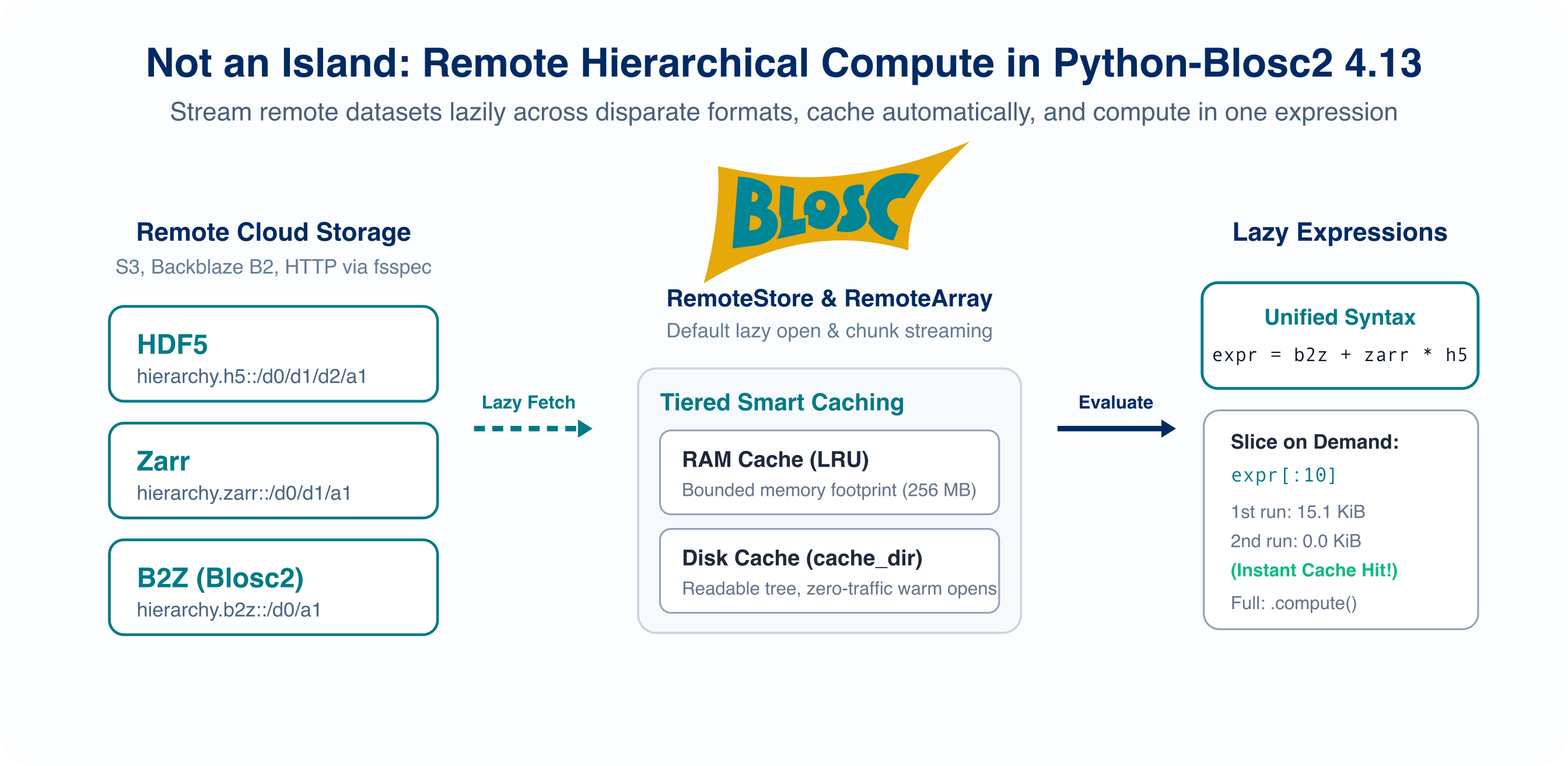
import blosc2

base = "https://s3.us-west-001.backblazeb2.com/blosc2/hierarchy"

with (
    blosc2.open(f"{base}.h5::/d0/d1/d2/a1", lazy=True, cache_dir="remote-cache") as h5,
    blosc2.open(f"{base}.zarr::/d0/d1/a1", lazy=True, cache_dir="remote-cache") as zarr,
    blosc2.open(f"{base}.b2z::/d0/a1", lazy=True, cache_dir="remote-cache") as b2z,
):
    expr = b2z + zarr * h5
    print(expr[:10])  # fetches only the chunks needed for the first 10 values
    result = expr.compute()  # materializes the full result as an NDArray
The three leaves above have shape (10000,), so they can be combined directly. Keep HDF5 opens before Zarr opens when using several remote formats in one process.
Choosing between fsspec and Caterva2
When opening an individual dataset with lazy=True, both fsspec URLs and Caterva2 URLPaths return a RemoteArray, providing an identical user interface for slicing, caching, and introspection.
For multi-dataset containers (B2Z, Zarr, and HDF5), a RemoteStore is returned instead, providing container-level discovery and shared caching across fsspec protocols.
What differs between the transports is the types of remote objects each can open:
Remote object |
fsspec URL / RemoteStore |
Caterva2 |
|---|---|---|
Standalone contiguous |
Yes ( |
Yes |
NDArray leaf inside |
Yes ( |
Yes |
Zarr v2/v3 array |
Yes ( |
No |
HDF5 dataset |
Yes ( |
Yes |
Lazy or computed array |
No |
Yes |
fsspec supplies byte ranges. Python-Blosc2 parses the remote frame to discover its geometry and chunk offsets, making this route direct and efficient for standalone arrays.
Caterva2 understands dataset paths, array metadata, and slicing. It can therefore expose array-like data that is not stored as a standalone Blosc2 frame, as well as apply authentication or server-side computation. Use Caterva2’s navigation API to find a leaf in a remote hierarchy, then open that leaf with a
URLPath.
lazy=True changes when data is fetched; it does not expand the underlying storage formats supported by either route.
[!TIP] Browse remote hierarchies: To explore groups, inspect attributes, or preview arrays in remote
.b2z,.zarr, or.h5containers interactively in the terminal without downloading the complete container, use b2view (e.g.b2view s3://bucket/hierarchy.b2z). To navigate containers programmatically in Python, use RemoteStore.
Explore remote hierarchies with RemoteStore
When working with containers that hold multiple groups and datasets—such as .b2z, .zarr, or .h5 files—use RemoteStore to discover, navigate, and access the hierarchy:
import blosc2

with blosc2.RemoteStore("https://datasets.example.org/data.h5") as store:
    # 1. Discover immediate child groups and datasets (metadata only, no array data downloaded)
    print(store.keys())

    # 2. Inspect a node's kind and attributes
    info = store.get_info("experiment")
    print(info.kind)  # "group", "ndarray", or "unsupported"

    # 3. Read user metadata on groups or arrays
    print(store["experiment"].attrs[:])

    # 4. Access an array leaf and slice it
    temp = store["experiment/temperature"]
    values = temp[:100]  # fetches and caches only the requested slice
Persistent disk caching with cache_dir
Specify cache_dir when creating a RemoteStore to persist discovery metadata and downloaded chunks to local disk:
with blosc2.RemoteStore(
    "https://datasets.example.org/data.h5",
    cache_dir="./b2store_cache",
    max_cache_bytes=512 * 2**20,  # 512 MiB shared disk limit
) as store:
    temp = store["experiment/temperature"]
    values = temp[:100]
When reopening the same store later with the same cache_dir:
Discovery metadata (such as B2Z member offsets or HDF5 Kerchunk reference maps) is restored from local disk, avoiding repeated remote translation scans.
store.metadata_bytesreports the encoded manifest size.Retained leaf chunks are available immediately from disk without network transfers.
Single-owner locks ensure that concurrent processes do not corrupt the shared cache.
Lifetime and clean shutdown
Use context managers (
with blosc2.RemoteStore(...) as store:) for clean lifecycle management.Child handles (
RemoteArrayleaves or group views) remain usable even after the parentstorehandle closes.Transport sessions, HTTP connections, and disk cache locks are released automatically once the last dependent handle is closed or garbage collected.
Access HTTP/HTTPS, S3, and cloud storage
Because Python-Blosc2 uses fsspec under the hood, any remote protocol supported by fsspec can be used to open arrays lazily.
HTTP and HTTPS
Publicly accessible arrays on any web server, CDN, or object store URL can be opened directly over HTTP or HTTPS without requiring cloud-specific libraries or credentials:
import blosc2

# Standalone array over HTTPS:
a = blosc2.open("https://datasets.example.org/big.b2nd", lazy=True)

# Container dataset over HTTPS:
b = blosc2.open(
    "https://f001.backblazeb2.com/file/blosc2/hierarchy.b2z::/d0/a3",
    lazy=True,
)
S3 and cloud object stores
For arrays stored on Amazon S3 or S3-compatible cloud object stores (Backblaze B2, MinIO, Cloudflare R2, Ceph, Wasabi, etc.), install s3fs and open the s3:// URL:
# Using default credentials from environment or ~/.aws/credentials
a = blosc2.open("s3://bucket/big.b2nd", lazy=True)
Other cloud stores work similarly by installing their respective fsspec driver (e.g. gcsfs for Google Cloud gs:// or adlfs for Azure abfs://).
Storage options and authentication
Pass a storage_options dictionary to configure headers, credentials, or custom endpoints.
Options are forwarded directly to the underlying fsspec filesystem:
# For HTTP/HTTPS: custom headers or authentication tokens
a = blosc2.open(
    "https://datasets.example.org/private.b2nd",
    lazy=True,
    storage_options={"headers": {"Authorization": "Bearer <token>"}},
)

# For S3: AWS profiles, credentials, or custom endpoints
storage_options = {
    "profile": "blosc2",  # named profile from ~/.aws/credentials
    "endpoint_url": "https://s3.us-west-001.backblazeb2.com",  # custom endpoint
    # Or explicit keys:
    # "key": "AWS_ACCESS_KEY_ID",
    # "secret": "AWS_SECRET_ACCESS_KEY",
    # Or anonymous public access:
    # "anon": True,
}
a = blosc2.open("s3://bucket/big.b2nd", lazy=True, storage_options=storage_options)
Remote performance: latency, caching, and concurrency
Remote requests over HTTP or object stores typically incur 20–100 ms of latency per range request. Python-Blosc2 addresses this in two ways:
Caching: Chunks and blocks fetched for a slice are kept in the local cache (in RAM by default, or persisted to disk with
cache_dir=orcache_path=). Re-fetching previously read regions requires zero network round trips and zero bytes transferred.Concurrent fetches: Independent range requests for required chunks and blocks are issued concurrently in a thread pool (configured via
max_concurrency=, default 8).
The runnable script examples/remote/s3-access.py demonstrates opening .b2nd, .b2z, .zarr, and .h5 datasets over remote URLs (both S3 and HTTPS), timing metadata discovery vs. slice fetching, measuring network traffic with Traffic, and showing the impact of chunk caching.
Cache policies and memory management
Every lazy open uses a cache policy. By default, fetched data is cached in memory with a bound on retained compressed payload.
In-memory caching (CachePolicy.MEMORY — Default)
When opened without disk options, blosc2.open(..., lazy=True) retains fetched chunks in RAM as a RemoteArray with CachePolicy.MEMORY:
a = blosc2.open("s3://bucket/big.b2nd", lazy=True)
a[10:12, 500:600]  # fetched and cached in RAM
a[10:12, 500:600]  # served from memory cache (no network traffic)
In-memory caches use max_cache_bytes (defaults to 256 MiB) with automatic LRU eviction after operations, including failed fetches.
This is not a peak RAM limit: metadata, in-flight transfers, decompression buffers, and results are excluded.
Large operations can exceed it substantially.
# Custom in-memory limit (e.g. 512 MiB):
a = blosc2.open("s3://bucket/big.b2nd", lazy=True, max_cache_bytes=512 * 2**20)
Persistent disk caching (CachePolicy.DISK)
Set cache_dir or cache_path to persist fetched data across sessions (CachePolicy.DISK):
url = "s3://bucket/big.b2nd"

# Blosc2 manages a cache file inside a directory:
a = blosc2.open(url, lazy=True, cache_dir="./b2cache")
a[100:110, :50]  # fetched and stored under ./b2cache

# A later process can reuse the same cache:
a = blosc2.open(url, lazy=True, cache_dir="./b2cache")
a[100:110, :50]  # served from local disk (no network traffic)
For an individual RemoteArray, pass
cache_dir(Blosc2 creates the cache carrier inside that directory) orcache_path(to specify an exact carrier filename, such asbig-cache.b2nd).For a RemoteStore, pass
cache_dirto store discovered hierarchy metadata and all leaf caches together under that directory.In both cases, compressed chunks are retained up to
max_cache_bytes(defaults to 256 MiB; passmax_cache_bytes=Nonefor an unbounded disk cache that never evicts).If you want the on-disk carrier to be visible and predictable, set
cache_path="big-cache.b2nd"explicitly; otherwise Blosc2 may create its own cache filename under the configuredcache_dir.
Authenticated Caterva2 caches must be private to one user.
Reopen them under an equivalent authenticated blosc2.c2context(); do not share a cache directory between users.
Stateless streaming (CachePolicy.NONE)
To stream data without retaining any chunks after each operation, specify CachePolicy.NONE:
stream = blosc2.open(
    "s3://bucket/big.b2nd",
    lazy=True,
    cache_policy=blosc2.CachePolicy.NONE,
)
Each read pulls only the bytes required for the slice and retains no cache payload.
[!NOTE]
max_cache_bytesis applied after each operation completes. It bounds the retained compressed cache payload; it does not limit the temporary working set or the decompressed NumPy array requested by the caller.
Only what a slice touches
Blosc2 arrays are compressed in chunks, which are divided into smaller blocks. For a small slice, fetching only its blocks can avoid transferring most of a large chunk.
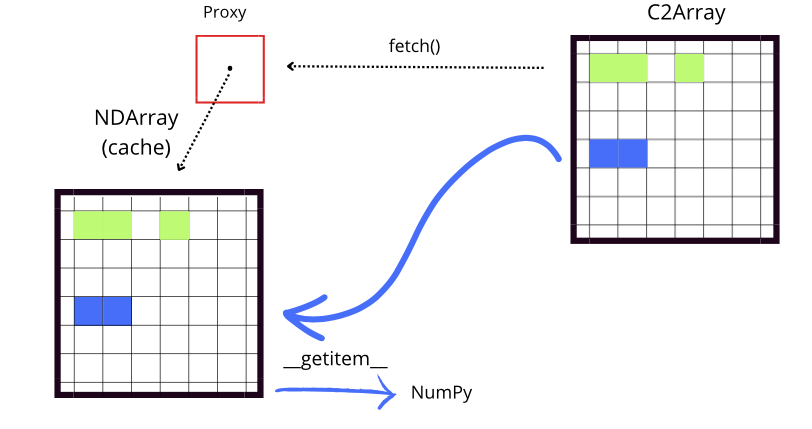
Purple regions are cached; red regions are still remote, and they do not use local storage.
The grid is schematic: where byte ranges are available, the fetched regions can be blocks within a chunk.
fetch() warms the cache and returns the remote array, whereas indexing returns the requested values.
The remote array chooses blocks or whole chunks automatically.
It fetches a whole chunk when most of its blocks are needed or when the source cannot expose block ranges, as with computed Caterva2 datasets.
Independent reads overlap, with up to eight concurrent requests by default; use max_concurrency=1 when concurrency does not help.
Stepped slices also use the block grid.
For example, a[::5] can reduce transfers along an axis whose blocks do not already span that axis.
Explicit cache pre-fetching
You can warm the cache proactively using fetch() or afetch():
# Synchronously pre-fetch a region into the cache:
a.fetch(slice(0, 10_000))

# Or asynchronously in an async event loop:
await a.afetch(slice(10_000, 20_000))
Both methods return a.
Prefetched data may be evicted to satisfy the cache limit; later indexing fetches it again as needed.
Use a.materialize(item) for an independent, complete NDArray.
Its output and temporary buffer are outside the cache limit.
[!NOTE]
fetch()andafetch()require a writable cache. On an immutable cache snapshot (such as an archive opened withmutable=False), pre-fetching raises an error.
a.cache exposes the underlying cache for inspection.
It may contain missing or evicted chunks and must not be treated as a complete array or mutated by callers.
Operations on a single handle are serialized through fetching, result assembly, eviction, and export. Async methods run synchronous operations in a worker thread; cancelling the await does not stop an already running fetch. Separate handles or processes sharing a disk carrier require external locking.
Measure network traffic
RemoteArray, RemoteStore, C2Array, and Proxy objects expose cumulative request and byte counts through Traffic. The count starts when the remote source is opened, so it includes metadata as well as array data:
a = blosc2.open("s3://bucket/big.b2nd", lazy=True)

a.traffic.reset()
corner = a[0, :100, :100]
print(a.traffic)  # requests and bytes fetched

a.traffic.reset()
corner = a[0, :100, :100]
print(a.traffic)  # Traffic(requests=0, nbytes=0) -> cache hit!
Use reset() or subtract two readings to measure one operation.
traffic is None for a local source because no network transport exists.
For a RemoteStore, store.traffic reports cumulative traffic across discovery and all leaf accesses in the session.
examples/remote/c2array-traffic.py compares block, chunk, and cached reads against a live Caterva2 dataset.
Persist and reopen remote references
Python-Blosc2 allows you to save remote references and their cached data to disk as portable files, and reopen them later without needing the original remote URL.
Persist a remote array reference (.b2nd)
Use RemoteArray directly when a .b2nd file should carry a portable remote descriptor and, optionally, its own bounded persistent cache:
remote = blosc2.RemoteArray(
    "s3://bucket/big.b2nd",
    cache_policy=blosc2.CachePolicy.NONE,
)
remote.save("big-reference.b2nd")

# Or create a named cache carrier explicitly:
remote = blosc2.open(
    "s3://bucket/big.b2nd",
    lazy=True,
    cache_path="big-cache.b2nd",
    mode="a",
)
remote[:100]
The saved object contains source and geometry metadata but no credentials.
A .b2nd carrier is a local cache/reference file for a remote array, not a second copy of the remote dataset itself: it stores the source locator plus any warm compressed chunks that have already been fetched. This is why a file such as big-cache.b2nd can be reopened later and continue serving cached reads without re-fetching the remote source. To create a visible file with a predictable name, set cache_path="big-cache.b2nd" when opening the remote array or call save("big-cache.b2nd") on the live handle.
With CachePolicy.NONE, repeated reads contact the source and do not mutate the carrier.
With CachePolicy.DISK, the carrier file itself is the cache and retains compressed chunks up to its payload limit.
Disk arrays preserve warm chunks by default; memory arrays export cold carriers.
Pass include_cache=False to export a cold copy without mutating the warm carrier.
Export a remote store snapshot (.b2z)
To export an entire remote hierarchy—including discovered groups, array geometry, source locators, and optional cached chunks—call save() on a RemoteStore:
with blosc2.RemoteStore("https://datasets.example.org/data.h5") as store:
    temp = store["experiment/temperature"]
    temp[:100]  # warms the cache for this slice

    # Save a portable .b2z reference archive containing discovery and warm chunks
    store.save("snapshot.b2z")

    # Or export a cold reference containing only metadata and locators (no chunks)
    store.save("cold_ref.b2z", include_cache=False)

    # Or export only a specific subtree
    store["experiment"].save("experiment_sub.b2z")
Portable reference: The
.b2zarchive contains the discovered hierarchy, attributes, and source locators (such as the HDF5 Kerchunk reference map or B2Z member offsets), but no secrets or credentials.include_cache=True(default): Bundles warm cached chunks along with metadata so reading previously fetched slices requires zero network traffic.include_cache=False: Omits cached payload chunks, producing a minimal reference archive for remote streaming.Subtree export: Calling
save()on a group view exports that subtree with relative child keys and the appropriate source root.
Reopen reference files with blosc2.open()
Both .b2nd array carriers and .b2z store snapshots can be reopened directly with blosc2.open():
# 1. Reopen an exported RemoteStore hierarchy:
with blosc2.open("snapshot.b2z") as restored:
    print(restored.keys())
    temp = restored["experiment/temperature"]
    values = temp[:100]  # served from archive if cached; fetched remotely if missing

# 2. Reopen a standalone RemoteArray carrier:
arr = blosc2.open("big-cache.b2nd", mode="a")
values = arr[:100]
Opening an exported .b2z archive automatically recognizes the remote store marker and constructs a RemoteStore. All leaves opened from it share one cache coordinator and budget.
Opening an on-disk carrier with mode="a" returns a RemoteArray and lets newly fetched regions extend the cache; opening with mode="r" keeps the cache file unchanged.
Legacy proxy caches created by older Blosc2 versions are also detected and reopened as a Proxy.
Independent reopening works for fsspec URLs, Caterva2 datasets, and persistent local Blosc2 sources.
The required runtime environment must still be available: fsspec backends and their configuration must be installed, local source paths must remain valid, and authenticated Caterva2 caches must be reopened inside an equivalent blosc2.c2context().
Caterva2 credentials are not stored in the cache file.
An arbitrary custom ProxyNDSource cannot be reconstructed because its Python class and runtime state are not serialized.
In that case, recreate the source explicitly and attach the existing cache with blosc2.Proxy(source, urlpath="big-cache.b2nd", mode="a").
Cache mutability: immutable vs. mutable snapshots
When saving an export, you can configure whether the resulting snapshot operates in immutable or mutable mode via the mutable argument (or the .mutable property on RemoteStore / RemoteArray):
# Default is mutable=False (immutable snapshot)
store.save("read_only.b2z", mutable=False)

# Or export a mutable snapshot
store.save("writable.b2z", mutable=True)
Mode |
Behavior when reopened |
Cache misses |
Modifying operations |
|---|---|---|---|
Immutable ( |
Reads directly in-place from |
Fetched transiently into RAM to satisfy the read; never written to disk or the archive. |
|
Mutable ( |
Staged into an independent writable runtime cache directory. Original |
Fetched and cached to disk under standard LRU eviction rules. |
Fully supported. Can be opened with a smaller budget, trimming excess chunks. |
[!TIP] Use immutable snapshots (
mutable=False) for sharing reproducible, read-only reference archives or distributing datasets that should never modify local storage. Use mutable snapshots (mutable=True) when users should be able to expand the local cache with newly fetched regions over time.
Retrieve scattered points
A remote array maps coordinate arrays and boolean masks to the blocks that contain their selected points:
a[rows, :100]
a[mask]
For Caterva2, a bare C2Array can be substantially more efficient for one-off point queries: it sends coordinates to the server, which evaluates the selection and returns only the selected values.
Prefer direct C2Array indexing for sparse, one-off point retrieval; prefer a RemoteArray when reuse through a local cache matters.
Handle remote changes
Standalone arrays and Caterva2 sources
A persistent cache records the source identity when one is available.
On a later blosc2.open() with the same cache_dir or cache_path, a mismatched cache is discarded and rebuilt automatically.
When constructing a proxy directly in append mode, a mismatch is reported instead:
p = blosc2.Proxy(source, urlpath="cache.b2nd", mode="a")
# ValueError if cache.b2nd belongs to different remote bytes
Use mode="w" to start that cache again.
If a source cannot provide an identity, compatibility is checked only from shape, dtype, chunks, and blocks.
Use a fresh cache when such a source may have changed without changing its geometry.
For a replaceable .b2nd or Caterva2 source, pass assume_immutable=False to check for updates and invalidate stale cached chunks before each operation.
Refreshing a RemoteStore
Remote containers (B2Z, Zarr, and HDF5) are assumed immutable by default.
If a remote container is updated on the server—such as adding new datasets or appending data—call store.refresh() to update discovery:
with blosc2.RemoteStore("https://datasets.example.org/data.h5") as store:
    # Refresh remote metadata atomically
    store.refresh()

    # Re-access datasets from the refreshed store
    array = store["experiment/temperature"]
Atomic update:
store.refresh()fetches fresh discovery from the remote source before updating the active generation. If discovery fails, the existing store state remains unchanged.Stale handle safety: Any child handles (
RemoteArrayleaves or group views) opened beforerefresh()become stale. Accessing them raises aRuntimeError, prompting you to look them up again from the refreshed store.Immutability rule: Calling
refresh()on an immutable reference snapshot (mutable=False) is disallowed and raises an error.
Fill a Caterva2 array concurrently
Several writers can fill one Caterva2 array when each chunk is written at most once. First create and upload an uninitialized array with its final geometry:
import blosc2
import numpy as np

blosc2.uninit(
    (1_000_000,),
    dtype=np.float64,
    chunks=(100_000,),
    blocks=(10_000,),
    urlpath="run.b2nd",
)
cat2-client upload run.b2nd @personal/run.b2nd
Each writer compresses and posts the chunks it owns:
import math

a = blosc2.C2Array("@personal/run.b2nd", urlbase="https://cat2.cloud/demo")
chunk = blosc2.compress2(
    data,
    typesize=a.dtype.itemsize,
    blocksize=math.prod(a.blocks) * a.dtype.itemsize,
)

try:
    a.update_chunk(nchunk, chunk)
except blosc2.ChunkAlreadyWritten:
    pass  # another writer completed this slot
The server serializes updates, and C2Array.written_chunks() reports progress from the array’s index:
written = a.written_chunks()
for nchunk in np.flatnonzero(~written):
    ...  # chunks still missing after a restart
Use your own transport
Subclass ByteRangeNDSource when the frame lives behind a transport that fsspec cannot use:
import boto3
import blosc2


class S3Source(blosc2.ByteRangeNDSource):
    def __init__(self, bucket, key):
        self.s3 = boto3.client("s3")
        self.bucket, self.key = bucket, key
        self.stamp = self.s3.head_object(Bucket=bucket, Key=key)["ETag"]
        super().__init__(f"s3://{bucket}/{key}")

    def read_range(self, offset, size):
        response = self.s3.get_object(
            Bucket=self.bucket,
            Key=self.key,
            Range=f"bytes={offset}-{offset + size - 1}",
        )
        data = response["Body"].read()
        self.traffic.charge(len(data))
        return data


a = blosc2.Proxy(S3Source("bucket", "big.b2nd"), urlpath="cache.b2nd", mode="a")
Initialize the transport before super().__init__(), because the base constructor immediately reads the frame header.
Make read_range() thread-safe, set stamp so persistent caches can detect changes, and charge the bytes read so traffic measurements remain accurate.
For ordinary remote access, use blosc2.open("https://...", lazy=True) or blosc2.open("s3://bucket/big.b2nd", lazy=True); the custom class only illustrates the transport contract.
See also
Tutorial 6 — a step-by-step introduction with output.
examples/remote/s3-access.py— remote access across Blosc2 (.b2nd, .b2z), Zarr, and HDF5 with timing and network traffic metering.examples/remote/store-browse.py— inspecting hierarchies, leaf previews, and shared caching across leaves.examples/remote/lazy-expr.py— evaluating a lazy expression over remote B2Z, Zarr, and HDF5 arrays.examples/remote/c2array-get-slice.py— opening and reading remote Caterva2 arrays via URLPath.examples/remote/c2array-traffic.py— block, chunk, and cached transfer sizes against Caterva2.examples/remote/c2array_expr.py— lazy expression evaluation on remote Caterva2 arrays.examples/remote/concurrent-fsspec.py— concurrent chunk fetching (max_concurrency) on high-latency stores.examples/remote/fsspec-cat2-access.py— one dataset and cache through fsspec and Caterva2.examples/remote/proxy-carray.py— creating a persistent local disk proxy of a remote Caterva2 array.examples/remote/rw-fsspec.py— fsspec reading and writing examples.b2view — interactive terminal browser for local and remote containers.
RemoteArray, RemoteStore, RemoteNode, C2Array, B2ZNDSource, ZarrNDSource, HDF5NDSource, FsspecNDSource, ByteRangeNDSource, Proxy, and Traffic — API reference pages.